Monday, February 15, 2010

Vampire Hunter D: The Novels


This past Friday, while browsing in Hasting's, I noticed one of these novels for sale. Hadn't known VHD had been novelized, though it didn't surprise me. I also noticed it's a serial collection and was curious to see what selection Barnes & Noble might have. Turns out B & N has nearly every title, and I bought 4 of them (will try to find a photo of the 4th tomorrow). I *love* Vampire Hunter D, immediately liked the original 1985 Anime film back then.

These books are NOT graphic novels. They are labeled as Manga, despite reading right to left and only containing 9 or 10 illustrations. The style is prose. The creator of VHD wrote these novels in the mid-1980s, and around 2006 they were finally translated into English. :-)

The cover art are gorgeous. I got these from Google Images and none of the scans really do the art justice.

Friday, February 12, 2010

Dracula, by Bram Stoker [1897] *Review 1*

After reading extensively about this classic novel in the book which accompanies "The Vampire Tarot" by Robert M. Place (that Tarot deck is based upon Stoker's novel), I decided to read the novel itself (my copy's cover is that shown).

Far be it from me to review "Dracula," much less approve of it, but wow -- it truly IS a masterpiece. On a scale of 1 to 5 stars it would rate 500. I'm halfway through the novel and will jot down my impressions of it so far.

First off, I'm amazed an Englishman of his day could write female characters (Mina and Lucy) so well. The ladies' diaries and letters sound so authentic, as if actually written by women of the time. All characters are likeable (except for the Count of course), and I've fallen in love with Jonathan Harker. ;-) A genuine Gothic atmosphere pervades the book, including fantasy-type imagery I wouldn't have thought possible for an author of the late 19th century.

At first I was skeptical the "diary/journal entries, letters, telegrams" style of the novel would work. Sometimes it is a bit difficult to imagine Mina or Dr. Seward not getting horrific writing cramps, but the style DOES work. The entire novel is written from a "collection" of each main character's 1st-person accounts and observations.

And it is precisely that which keeps this novel MOVING. It must have been considered a very fast-paced and exhilirating read in 1897 because it keeps this 21st century gal turning the pages. You know how old novels tend to be: It takes the author 10 pages to move characters from exiting the door to being down at lane's end picking daisies. :-P Yeah, I know life was slower then...but Stoker's novel is NOT like that. It keeps clipping right along.

Stoker was bold and daring. It paid off.

Will write 2nd and final review when I've completed this treasure.

Sunday, February 7, 2010

Blade Runner [1982]

Ah, Blade Runner; what's not to love? Who didn't find the opening scene of "The Hades Landscape" breathtaking, and with the Vangelis soundtrack combined? Magnificent.

It needs no review from me. I love sci-fi and while this isn't "a Gothic," I definitely do enjoy the dark mood and brooding quality of the film - particularly in the winter; this is a winter film for me. The detective aspect of it is another draw, and I prefer the version which contains Deckard's monologue.

The city. Who wouldn't be drawn for a visit?

And the lovely Rachael. She's my favorite character. I only wish they'd written something profound for her to say.

I missed seeing the film in a theater in 1982. I hope it's re-released to the Big Screen for its 30th (gosh...can it be??) anniversary in 2012.

*First posted this in January 2009. I enjoy the film so much, particularly this time of the year, I couldn't resist reposting it.*

Friday, February 5, 2010

The Master of the Blue Mire [cover scan]

I found this day before last at an online bookseller's site. It's a beautiful cover which immediately caught my eye, particularly the blueness. You can see the splashing of water as the girl hurriedly steps into a pond.

As Photobucket.com won't open for me today (it's so glitchy), I've gone back to the web site and copied the page where the cover appears LARGE:

http://tinyurl.com/yf27zm8

The publication year was listed as 1971. I'd like to have this novel and will check local used bookstore; they've got half a dozen Coffman titles.

Friday, January 22, 2010

Bride of Darkness, by Margery Lawrence [1967]

Correct cover art, different title and author. This book's title is in bold white letters at upper left-hand corner. The true color is a sinister bile green with mossy hightlights. In the lower right-hand corner are these words in white italics: "Beneath the lovely facade of a modern young wife lurked an evil -- as ancient and indestructible as time."

The story purports to be true. Its author, Margery Lawrence, begins in the Foreword: "Most readers of this book will regard it as a piece of pure fantasy, but in fact it is not. It is the true and exact account (except in a few places where I have altered the 'coloring' of the story in order to avoid any possible identification with places or people) of the marriage of a friend whom I will call, for obvious reasons, Mr. X. Mr. X is a scientist of considerable attainments..."

Blah blah. The story opens on Keith Randolph, 27-ish Englishman. The story is told from his perspective. While on business in Italy on his father's behalf, Keith meets Gilda: A gorgeous red-headed sculptor, and a widow, who works in her father's home. Her father is a wealthy collector and antiquarian. Keith is madly attracted to Gilda; she's smooth and coy. Soon they're married and burning up the marriage bed. She'd always wanted an English husband, and soon they settle in London. Things go fine for a while; Gilda has a few oddities about her, including refusal to take any salt in her food. She's also always offering to "do" other peoples' hair and nails; claims to have been a former stylist and manicurist. Keith's father, wealthy in his own right, becomes progressively ill. Keith finds little envelopes filled with hair clippings and nail trimmings of various people (their names are written on each envelope in Gilda's hand) in a mysterious box in her work desk. Hmmmm! Soon Gilda becomes pregnant; and she's FURIOUS about it. The baby (Noel) is born and Gilda shows no care for her child; let the nanny do everything. She's cold, callus, super-selfish; Keith becomes increasingly frustrated and enraged by Gilda's "turn" of character.

But a bright spot in Keith's life: Chloris. She's the daughter of his father's long-time Grecian friend (or something). Chloris and her Aunt Mary relocate to London as well; Chloris begins working for a magazine. They've known each other for ages and Keith gradually begins to fall in love with Chloris. Aunt Mary's lady servant recognizes Gilda for what she is: A witch! Despite the shocked utterance accompanied by fainting on the woman's part, despite all evidence he's seen/experienced, Keith is "shocked" and must run to a dictionary to ensure he understood the Greek word the woman used against his wife. Right.

As the Randolphs' marriage continues to sour and the health of their son, Noel, continues to falter, Gilda is suddenly summoned to Italy: Her father. Who soon dies. Seems lots of people die around Gilda at the most opportune times. Meanwhile, Keith nobly plans how to save his faltering infant son, Noel, from his mother; she's away in Italy and he has time...which he fritters away wringing his hands when he's not taking Chloris out for drinks and dancing. >:-( It's very easy to see the social mores/values of the time in these old novels: An angry witch will carry a child to term rather than abort it; a man cannot divorce his wife and must stand idly by (sort of) until she returns home.

The story is chatty, chatty, chatty. Lots of descriptives of dress, hairstyles, jewelry. Painstaking detail about EVERYTHING. That was a major turnoff, and after page 108 I had enough and skimmed to the ending:

Which is happy of course. Gilda gets hers in the end. Noel is spared (thankfully!), Keith and Chloris are free to love and marry; they have 3 children.

I give it 3 stars out of 5. It's good writing and entertaining, just...tedious.

Thursday, January 21, 2010

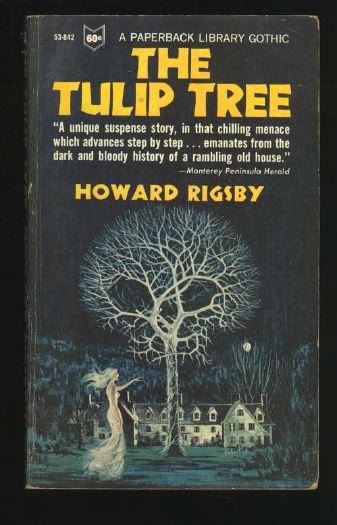
The Tulip Tree (cover scan) - *ENLARGED*


Absinthe of the former "Gloomy Sunday" blog scanned this. She offered me copy/use of her images...and then she was gone (November '08).

I've not been able to find this book/cover locally.

This post is in honor of Shaun's friendship: Seven years of fun discussing astronomy, planetary science, manned spaceflight and Mars colonization at two message boards. Farewell, my Aussie friend. :*-(

p.s.: Finally got stupid Photobucket to open/work. Enjoy the larger version.

Saturday, January 16, 2010

Girl on the Moon & Her Vampire

Image from "The Vampire Tarot" by Robert M. Place, found via Google Images. Last night while continuing to read the accompanying book, I came across the author's reference to a patient of Jung's. Mr. Place quotes the source of the case -- Jung's "Memories, Dreams, Reflections" -- which I read probably 5 years ago. Mr. Place retells the case perfectly, and I thought it might be of interest, so I'll quote him:

"Jung related a fantasy of an 18-year-old female catatonic patient under his care, in which a vampire symbolized her Animus and became the catalyst for her healing. As he stated later, her condition stemmed from being seduced by her brother. Because incest is traditionally associated with royalty and divinities, this experience transported her to a mythic realm. She gradually became more and more isolated and odd, until she was completely silent. Jung worked with her for weeks, and when he finally persuaded her to speak, she depicted her catatonic state as a fantasy in which she had been living on the moon.

She said that the men on the moon kept their wives and children in sublunar dwellings so that they would be safe from a vampire who lived in the mountains. As a favor to the moon people, the patient planned to destroy the vampire. To accomplish this, she waited for him on a tower erected for this purpose and had a sacrificial knife concealed under her gown. Day after day she waited until he drew close. His appearance was that of a large black bird with several pairs of wings. His iridescent black feathers totally hid his face, and when he was finally within reach she was seized by a curiosity to find out what he looked like. Suddenly the wings opened, revealing a man of unearthly beauty, and she was spellbound and unable to strike. Then, the vampire seized her with an iron grip and flew away with her.

After this, she was able to speak and could no longer return to her catatonic state. Gradually she returned to complete health, was married and had a natural full life.

When the female patient began to wonder what her Animus looked like, she began to interact with him consciously and he transformed into a healing catalyst."

Cool huh? ;-)